

1

2

3

4

5

6

7

8

9

10

11

12

13

14

15

16

17

18

19

20

21

22

23

24

25

26

27

28

29

30

31
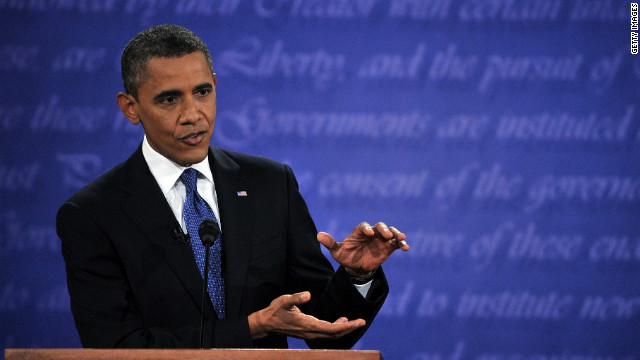
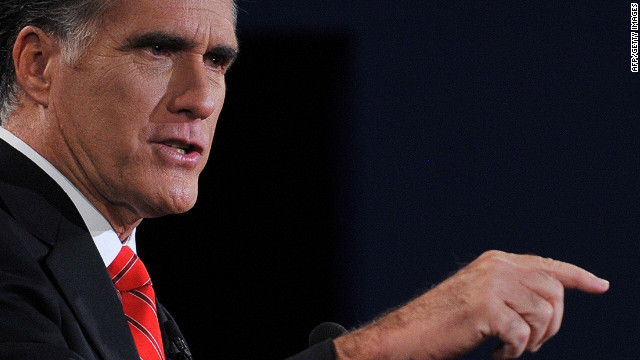
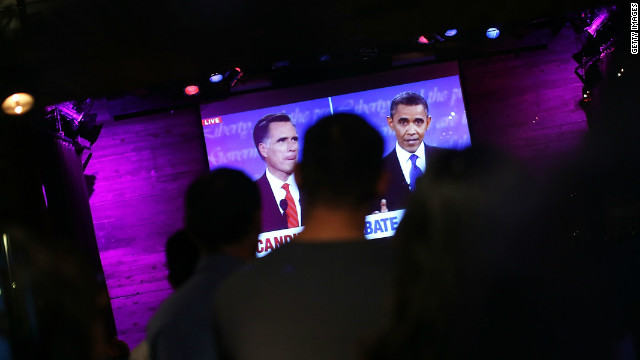
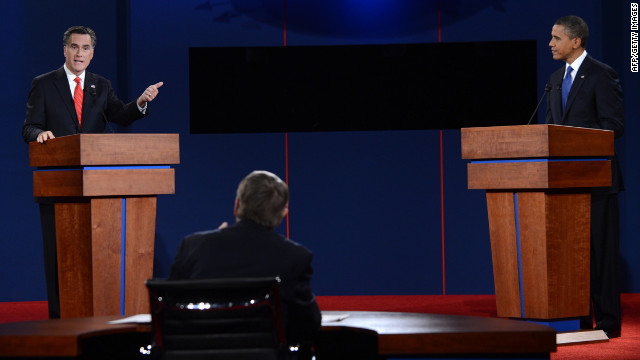
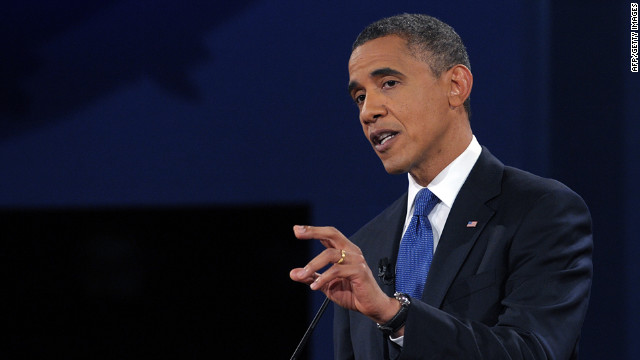
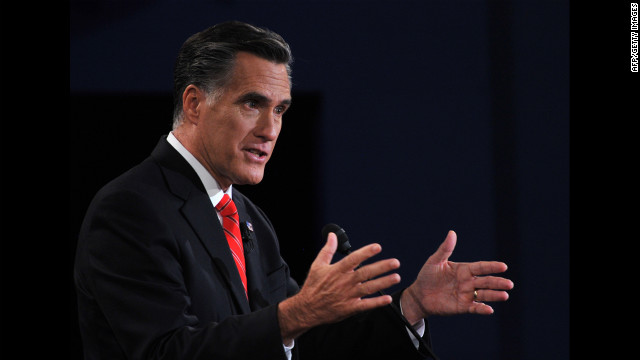
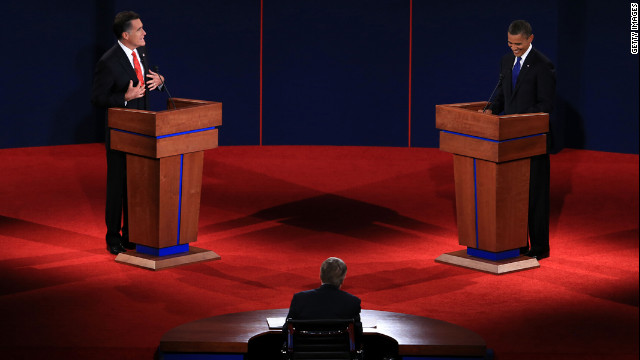
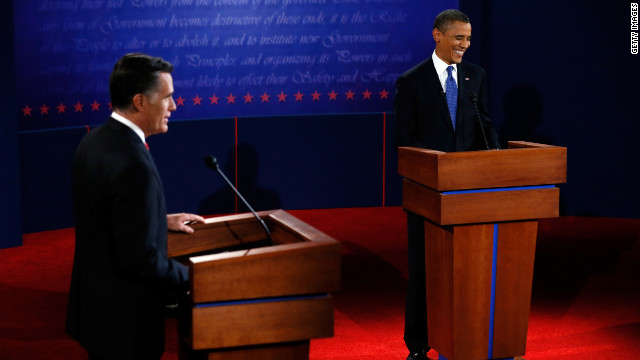
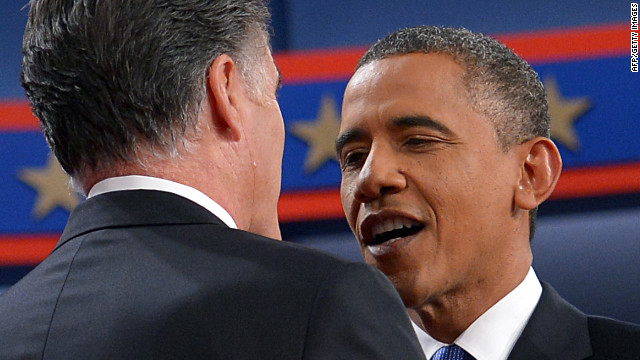
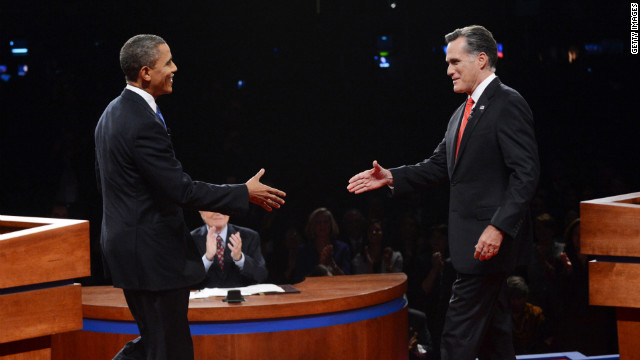
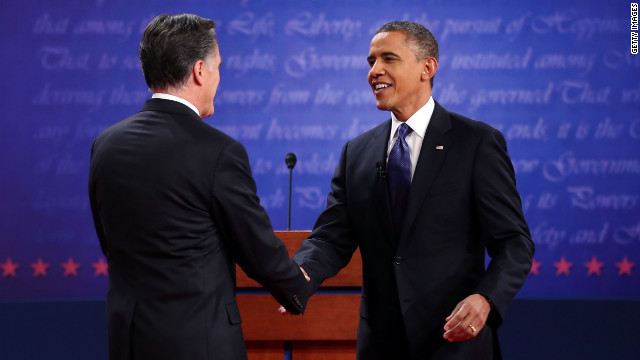
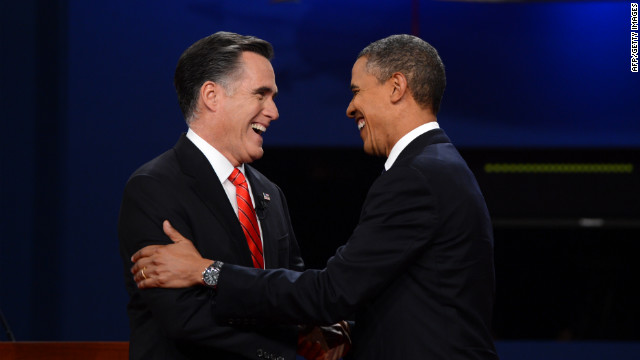
Denver (CNN) -- Following is a transcript of Wednesday evening's presidential debate in Denver. It will be continually updated until the debate concludes.
(APPLAUSE)
JIM LEHRER: Thirty seconds, folks. Let's have a terrific evening,
for all of you and for our country.
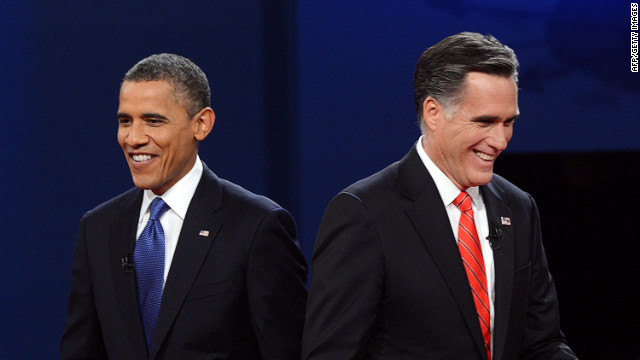
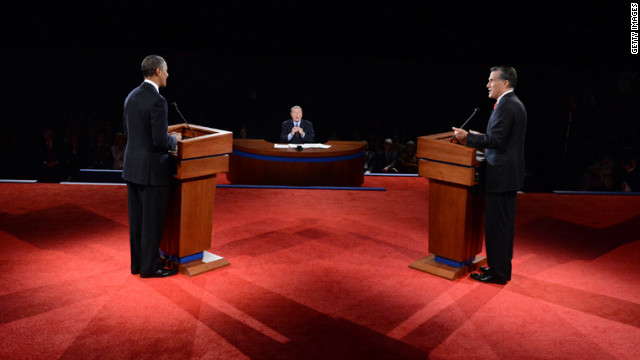
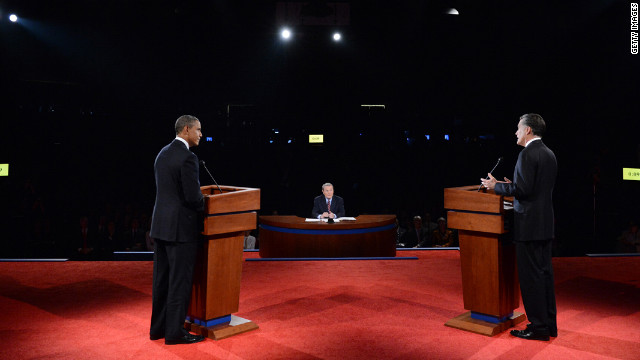
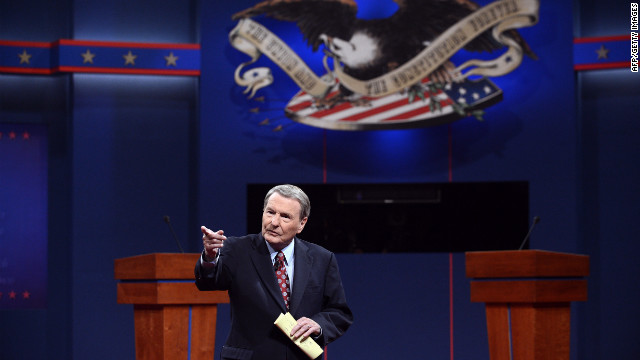
Good evening from the Magness Arena at the University of Denver
in Denver, Colorado. I'm Jim Lehrer of the "PBS NewsHour," and I
welcome you to the first of the 2012 presidential debates between
President Barack Obama, the Democratic nominee, and former
Massachusetts Governor Mitt Romney, the Republican nominee.
This debate and the next three -- two presidential, one
vice presidential -- are sponsored by the Commission on Presidential
Debates. Tonight's 90 minutes will be about domestic issues and will
follow a format designed by the commission. There will be six roughly
15-minute segments with two-minute answers for the first question,
then open discussion for the remainder of each segment.
Thousands of people offered suggestions on segment subjects or
questions via the Internet and other means, but I made the final
selections. And for the record, they were not submitted for approval
to the commission or the candidates.
The segments as I announced in advance will be three on the
economy and one each on health care, the role of government and
governing, with an emphasis throughout on differences, specifics and
choices. Both candidates will also have two-minute closing
statements.
The audience here in the hall has promised to remain silent -- no
cheers, applause, boos, hisses, among other noisy distracting things,
so we may all concentrate on what the candidates have to say. There
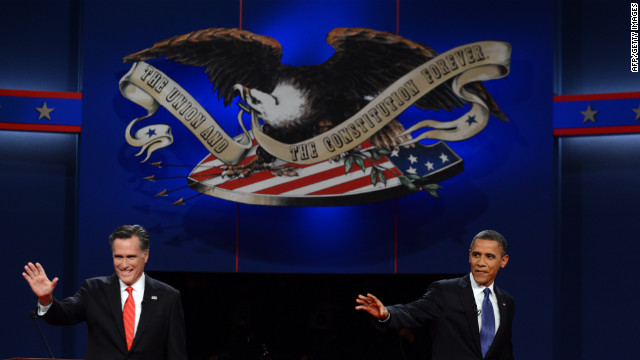
is a noise exception right now, though, as we welcome President Obama
and Governor Romney.
(APPLAUSE)
Gentlemen, welcome to you both. Let's start the economy, segment
one, and let's begin with jobs. What are the major differences
between the two of you about how you would go about creating new jobs?
You have two minutes. Each of you have two minutes to
start. A coin toss has determined, Mr. President, you go first.
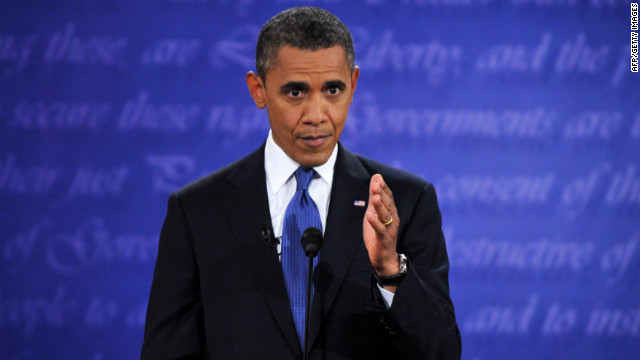
PRESIDENT OBAMA: Well, thank you very much, Jim, for this opportunity. I
want to thank Governor Romney and the University of Denver for your
hospitality.
There are a lot of points I want to make tonight, but the most
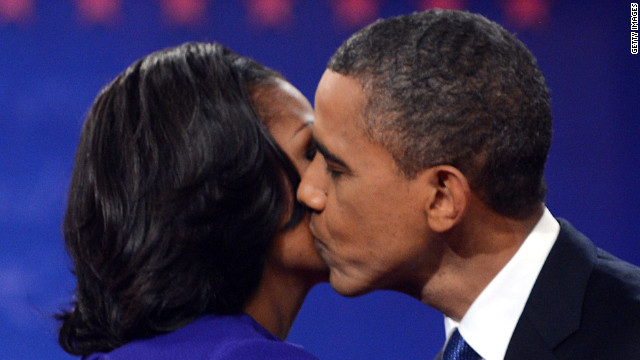
important one is that 20 years ago I became the luckiest man on Earth
because Michelle Obama agreed to marry me.
And so I just want to wish, Sweetie, you happy anniversary and
let you know that a year from now we will not be celebrating it in
front of 40 million people.
(LAUGHTER)
You know, four years ago we went through the worst financial
crisis since the Great Depression. Millions of jobs were lost, the
auto industry was on the brink of collapse. The financial system had
frozen up.
And because of the resilience and the determination of the
American people, we've begun to fight our way back. Over the last 30
months, we've seen 5 million jobs in the private sector created. The
auto industry has come roaring back. And housing has begun to rise.
But we all know that we've still got a lot of work to do. And so
the question here tonight is not where we've been, but where we're
going.
Governor Romney has a perspective that says if we cut taxes,
skewed towards the wealthy, and roll back regulations, that we'll be
better off. I've got a different view.
I think we've got to invest in education and training. I think
it's important for us to develop new sources of energy here in
America, that we change our tax code to make sure that we're helping
small businesses and companies that are investing here in the United
States, that we take some of the money that we're saving as we wind
down two wars to rebuild America and that we reduce our deficit in a
balanced way that allows us to make these critical investments.
Now, it ultimately is going to be up to the voters, to you, which path we should take. Are
we going to double-down on the top-down economic policies that helped
to get us into this mess? Or do we embrace a new economic patriotism
that says America does best when the middle class does best? And I'm
looking forward to having that debate.
LEHRER: Governor Romney, two minutes.
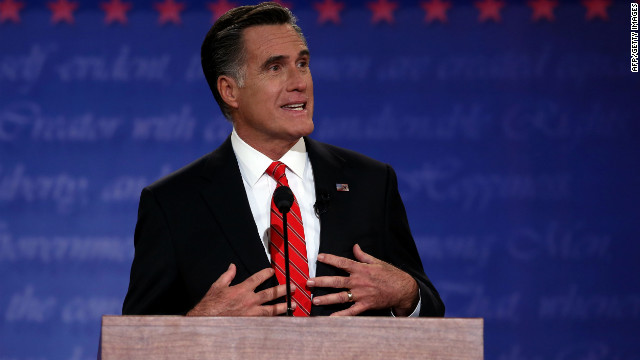
GOV. MITT ROMNEY: Thank you, Jim. It's an honor to be here with you, and
I appreciate the chance to be with the president. I'm pleased to be
at the University of Denver, appreciate their welcome, and also the
presidential commission on these debates.
And congratulations to you, Mr. President, on your anniversary.
I'm sure this was the most romantic place you could imagine here --
here with me. So I...
(LAUGHTER)
Congratulations.
This is obviously a very tender topic. I've had the occasion
over the last couple of years of meeting people across the country. I
was in Dayton, Ohio, and a woman grabbed my arm, and she said, "I've
been out of work since May. Can you help me?"
Ann yesterday was at a rally in Denver, and a woman came up to
her with a baby in her arms, and said, "Ann, my husband has had four
jobs in three years, part-time jobs. He's lost his most recent job.
And we've now just lost our home. Can you help us?"
And the answer is, yes, we can help, but it's going to take a
different path, not the one we've been on, not the one the president
describes as a top-down, cut taxes for the rich. That's not what I'm
going to do.
My plan has five basic parts. One, get us energy independent,
North American energy independent. That creates about 4 million jobs.
Number two, open up more trade, particularly in Latin America, crack
down on China, if and when they cheat. Number three, make sure our
people have the skills they need to succeed and the best schools in
the world. We're a far way from that now. Number four, get us to a
balanced budget.
Number five, champion small business. It's small business that
creates the jobs in America. And over the last four years, small-
business people have decided that America may not be the place to open
a new business, because new business startups are down to a 30-year
low. I know what it takes to get small business growing again, to
hire people.
ROMNEY: Now, I'm concerned that the path that we're on has just
been unsuccessful. The president has a view very similar to the view
he had when he ran four years, that a bigger government, spending
more, taxing more, regulating more -- if you will, trickle-down
government -- would work.
That's not the right answer for America. I'll restore the
vitality that gets America working again. Thank you.
LEHRER: Mr. President, please respond directly to what the
governor just said about trickle-down -- his trick-down approach, as
he said yours is.
OBAMA: Well, let me talk specifically about what I think we need
to do. First, we've got to improve our education system and we've
made enormous progress drawing on ideas both from Democrats and
Republicans that are already starting to show gains in some of the
toughest to deal with schools. We've got a program called Race to the
Top that has prompted reforms in 46 states around the country, raising
standards, improving how we train teachers.
So now I want to hire another 100,000 new math and science
teachers, and create 2 million more slots in our community colleges so
that people can get trained for the jobs that are out there right now.
And I want to make sure that we keep tuition low for our young people.
When it comes to our tax code, Governor Romney and I both agree
that our corporate tax rate is too high, so I want to lower it,
particularly for manufacturing, taking it down to 25 percent. But I
also want to close those loopholes that are giving incentives for
companies that are shipping jobs overseas. I want to provide tax
breaks for companies that are investing here in the United States.
On energy, Governor Romney and I, we both agree that we've got to
boost American energy production, and oil and natural gas production
are higher than they've been in years. But I also believe that we've
got to look at the energy sources of the future, like wind and solar
and biofuels, and make those investments.
So all of this is possible. Now, in order for us to do
it, we do have to close our deficit, and one of the things I'm sure
we'll be discussing tonight is, how do we deal with our tax code? And
how do we make sure that we are reducing spending in a responsible
way, but also, how do we have enough revenue to make those
investments?
And this is where there's a difference, because Governor Romney's
central economic plan calls for a $5 trillion tax cut -- on top of the
extension of the Bush tax cuts -- that's another trillion dollars --
and $2 trillion in additional military spending that the military
the deficit, and make the investments that we need to make, without
dumping those costs onto middle-class Americans, I think is one of the
central questions of this campaign.
LEHRER: Both of you have spoken about a lot of different things,
and we're going to try to get through them in as specific a way as we
possibly can.
But, first, Governor Romney, do you have a question that you'd
like to ask the president directly about something he just said?
ROMNEY: Well, sure. I'd like to clear up the record and go
through it piece by piece.
First of all, I don't have a $5 trillion tax cut. I don't have a
tax cut of a scale that you're talking about. My view is that we
ought to provide tax relief to people in the middle class. But I'm
not going to reduce the share of taxes paid by high-income people.
High-income people are doing just fine in this economy. They'll do
fine whether you're president or I am.
The people who are having the hard time right now are middle-
income Americans. Under the president's policies, middle-income
Americans have been buried. They're just being crushed. Middle-
income Americans have seen their income come down by $4,300. This is
a -- this is a tax in and of itself. I'll call it the economy tax.
It's been crushing.
At the same time, gasoline prices have doubled under the
president. Electric rates are up. Food prices are up. Health care
costs have gone up by $2,500 a family. Middle-income families are
being crushed.
ROMNEY: And so the question is how to get them going again. And
I've described it. It's energy and trade, the right kind of training
programs, balancing our budget and helping small business. Those are
the -- the cornerstones of my plan.
But the president mentioned a couple of other ideas I'll just
note. First, education. I agree: Education is key, particularly the
future of our economy. But our training programs right now, we've got
47 of them, housed in the federal government, reporting to eight
different agencies. Overhead is overwhelming. We've got to get those
dollars back to the states and go to the workers so they can create
their own pathways to get in the training they need for jobs that will
really help them.
The second area, taxation, we agree, we ought to bring the tax
rates down. And I do, both for corporations and for individuals. But
in order for us not to lose revenue, have the government run out of
money, I also lower deductions and credits and exemptions, so that we
keep taking in the same money when you also account for growth.
The third area, energy. Energy is critical, and the president
pointed out correctly that production of oil and gas in the U.S. is
up. But not due to his policies. In spite of his policies.
Mr. President, all of the increase in natural gas and oil has
happened on private land, not on government land. On government land,
your administration has cut the number of permits and licenses in
half. If I'm president, I'll double them, and also get the -- the oil
from offshore and Alaska. And I'll bring that pipeline in from
Canada.
And, by the way, I like coal. I'm going to make sure we can
continue to burn clean coal. People in the coal industry feel like
it's getting crushed by your policies. I want to get America and
North America energy independent so we can create those jobs.
And finally, with regards to that tax cut, look, I'm not looking
to cut massive taxes and to reduce the -- the revenues going to the
government. My -- my number-one principal is, there will be no tax
cut that adds to the deficit. I want to underline that: no tax cut
that adds to the deficit.
But I do want to reduce the burden being paid by middle-income
Americans. And I -- and to do that, that also means I cannot reduce
the burden paid by high-income Americans. So any -- any language to
the contrary is simply not accurate.
LEHRER: Mr. President?
OBAMA: Well, I think -- let's talk about taxes, because I think
it's instructive. Now, four years ago, when I stood on this stage, I
said that I would cut taxes for middle-class families. And that's
exactly what I did. We cut taxes for middle-class families by about
$3,600.
And the reason is, because I believe that we do best when the
middle class is doing well. And by giving them those tax cuts, they
had a little more money in their pocket, and so maybe they can buy a
new car. They are certainly in a better position to weather the
extraordinary recession that we went through. They can buy a computer
for their kid who's going off to college, which means they're spending
more money, businesses have more customers, businesses make more
profits, and then hire more workers.
Now, Governor Romney's proposal that he has been promoting for 18
months calls for a $5 trillion tax cut, on top of $2 trillion of
additional spending for our military. And he is saying that he is
going to pay for it by closing loopholes and deductions. The problem
deductions and loopholes, and he hasn't been able to identify them.
But I'm going to make an important point here, Jim.
LEHRER: All right.
OBAMA: When you add up all the loopholes and deductions that
upper-income individuals can -- are currently taking advantage of, you
take those all away, you don't come close to paying for $5 trillion in
tax cuts and $2 trillion in additional military spending.
OBAMA: And that's why independent studies looking at this said
the only way to meet Governor Romney's pledge of not reducing the
deficit or -- or -- or not adding to the deficit is by burdening
middle-class families. The average middle-class family with children
would pay about $2,000 more.
Now, that's not my analysis. That's the analysis of economists
who have looked at this. And -- and that kind of top -- top-down
economics, where folks at the top are doing well, so the average
person making $3 million is getting a $250,000 tax break, while
middle-class families are burdened further, that's not what I believe
is a recipe for economic growth.
LEHRER: All right. What is the difference? Let's just stay on
taxes.
(CROSSTALK)
LEHRER: Just -- let's just stay on taxes for (inaudible).
(CROSSTALK)
LEHRER: What is the difference...
ROMNEY: Well, but -- but virtually -- virtually everything he
just said about my tax plan is inaccurate.
LEHRER: All right.
ROMNEY: So if the tax plan he described were a tax plan I was
trillion tax cut. What I've said is I won't put in place a tax cut
that adds to the deficit. That's part one. So there's no economist
that can say Mitt Romney's tax plan adds $5 trillion if I say I will
not add to the deficit with my tax plan.
Number two, I will not reduce the share paid by high-income
individuals. I know that you and your running mate keep saying that
and I know it's a popular thing to say with a lot of people, but it's
just not the case. Look, I've got five boys. I'm used to people
saying something that's not always true, but just keep on repeating it
and ultimately hoping I'll believe it. But that -- that is not the
case. All right? I will not reduce the taxes paid by high-income
Americans.
And number three, I will not under any circumstances raise taxes
on middle-income families. I will lower taxes on middle-income
families. Now, you cite a study. There are six other studies that
looked at the study you describe and say it's completely wrong. I saw
a study that came out today that said you're going to raise taxes by
$3,000 to $4,000 on middle-income families.
There are all these studies out there. But let's get at the
bottom line. That is, I want to bring down rates. I want to bring
the rates down, at the same time lower deductions and exemptions and
credits and so forth, so we keep getting the revenue we need. And
you'd think, well, then why lower the rates?
ROMNEY: And the reason is because small business pays that
individual rate; 54 percent of America's workers work in businesses
that are taxed not at the corporate tax rate, but at the individual
tax rate. And if we lower that rate, they will be able to hire more
people. For me, this is about jobs. This is about getting jobs for
the American people.
(CROSSTALK)
LEHRER: That's where we started. Yeah.
Do you challenge what the governor just said about his own plan?
OBAMA: Well, for 18 months he's been running on this tax plan.
And now, five weeks before the election, he's saying that his big,
bold idea is, "Never mind."
And the fact is that if you are lowering the rates the way you
described, Governor, then it is not possible to come up with enough
deductions and loopholes that only affect high-income individuals to
avoid either raising the deficit or burdening the middle class. It's
-- it's math. It's arithmetic.
Now, Governor Romney and I do share a deep interest in
encouraging small-business growth. So at the same time that my tax
plan has already lowered taxes for 98 percent of families, I also
lowered taxes for small businesses 18 times. And what I want to do is
continue the tax rates -- the tax cuts that we put into place for
small businesses and families.
But I have said that for incomes over $250,000 a year, that we
should go back to the rates that we had when Bill Clinton was
president, when we created 23 million new jobs, went from deficit to
surplus, and created a whole lot of millionaires to boot.
And the reason this is important is because by doing that, we
cannot only reduce the deficit, we cannot only encourage job growth
through small businesses, but we're also able to make the investments
that are necessary in education or in energy.
And we do have a difference, though, when it comes to
definitions of small business. Under -- under my plan, 97 percent of
small businesses would not see their income taxes go up. Governor
Romney says, well, those top 3 percent, they're the job creators,
they'd be burdened.
But under Governor Romney's definition, there are a whole bunch
of millionaires and billionaires who are small businesses. Donald
Trump is a small business. Now, I know Donald Trump doesn't like to
think of himself as small anything, but -- but that's how you define
small businesses if you're getting business income.
And that kind of approach, I believe, will not grow our economy,
because the only way to pay for it without either burdening the middle
class or blowing up our deficit is to make drastic cuts in things like
education, making sure that we are continuing to invest in basic
science and research, all the things that are helping America grow.
And I think that would be a mistake.
LEHRER: All right.
ROMNEY: Jim, let me just come back on that -- on that point,
which is these...
LEHRER: Just for the -- just for record...
(CROSSTALK)
ROMNEY: ... the small businesses we're talking about...
LEHRER: Excuse me. Excuse me. Just so everybody understands,
we're way over our first 15 minutes.
ROMNEY: It's fun, isn't it?
LEHRER: It's OK, it's great. No problem. Well, you all don't
have -- you don't have a problem, I don't have a problem, because
we're still on the economy. We're going to come back to taxes. I
want move on to the deficit and a lot of other things, too.
OK, but go ahead, sir.
ROMNEY: You bet. Well, President, you're -- Mr. President,
you're absolutely right, which is that, with regards to 97 percent of
the businesses are not -- not taxed at the 35 percent tax rate,
they're taxed at a lower rate. But those businesses that are in the
last 3 percent of businesses happen to employ half -- half of all the
people who work in small business. Those are the businesses that
employ one-quarter of all the workers in America. And your plan is to
take their tax rate from 35 percent to 40 percent.
Now, and -- and I've talked to a guy who has a very small
business. He's in the electronics business in -- in St. Louis. He
has four employees. He said he and his son calculated how much they
pay in taxes, federal income tax, federal payroll tax, state income
tax, state sales tax, state property tax, gasoline tax. It added up
to well over 50 percent of what they earned. And your plan is to take
the tax rate on successful small businesses from 35 percent to 40
percent. The National Federation of Independent Businesses has said
that will cost 700,000 jobs.
I don't want to cost jobs. My priority is jobs. And so what I
do is I bring down the tax rates, lower deductions and exemptions, the
same idea behind Bowles-Simpson, by the way, get the rates down, lower
deductions and exemptions, to create more jobs, because there's
nothing better for getting us to a balanced budget than having more
people working, earning more money, paying more taxes. That's by far
the most effective and efficient way to get this budget balanced.
OBAMA: Jim, I -- you may want to move onto another topic, but I
-- I would just say this to the American people. If you believe that
we can cut taxes by $5 trillion and add $2 trillion in additional
spending that the military is not asking for, $7 trillion -- just to
ROMNEY: We didn't put in place a board that can tell people
ultimately what treatments they're going to receive. We didn't also
do something that I think a number of people across this country
recognize, which is put -- put people in a position where they're
going to lose the insurance they had and they wanted.
Right now, the CBO says up to 20 million people will lose their
insurance as Obamacare goes into effect next year. And likewise, a
study by McKinsey and Company of American businesses said 30 percent
of them are anticipating dropping people from coverage.
So for those reasons, for the tax, for Medicare, for this board,
and for people losing their insurance, this is why the American people
don't want Medicare -- don't want Obamacare. It's why Republicans
said, do not do this, and the Republicans had -- had the plan. They
put a plan out. They put out a plan, a bipartisan plan. It was swept
aside.
I think something this big, this important has to be done on a
bipartisan basis. And we have to have a president who can reach
across the aisle and fashion important legislation with the input from
both parties.
OBAMA: Governor Romney said this has to be done on a bipartisan
basis. This was a bipartisan idea. In fact, it was a Republican
idea. And Governor Romney at the beginning of this debate wrote and
said what we did in Massachusetts could be a model for the nation.
And I agree that the Democratic legislators in Massachusetts
might have given some advice to Republicans in Congress about how to
cooperate, but the fact of the matter is, we used the same advisers,
and they say it's the same plan.
It -- when Governor Romney talks about this board, for example,
unelected board that we've created, what this is, is a group of health
care experts, doctors, et cetera, to figure out, how can we reduce the
cost of care in the system overall?
Because there -- there are two ways of dealing with our health
care crisis. One is to simply leave a whole bunch of people uninsured
and let them fend for themselves, to let businesses figure out how
long they can continue to pay premiums until finally they just give
up, and their workers are no longer getting insured, and that's been
the trend line.
Or, alternatively, we can figure out, how do we make the cost of
care more effective? And there are ways of doing it.
So at Cleveland Clinic, one of the best health care systems in
the world, they actually provide great care cheaper than average. And
the reason they do is because they do some smart things. They -- they
say, if a patient's coming in, let's get all the doctors together at
once, do one test instead of having the patient run around with 10
tests. Let's make sure that we're providing preventive care so we're
catching the onset of something like diabetes. Let's -- let's pay
providers on the basis of performance as opposed to on the basis of
how many procedures they've -- they've engaged in.
Now, so what this board does is basically identifies best
practices and says, let's use the purchasing power of Medicare and
Medicaid to help to institutionalize all these good things that we do.
And the fact of the matter is that, when Obamacare is fully
implemented, we're going to be in a position to show that costs are
going down. And over the last two years, health care premiums have
gone up -- it's true -- but they've gone up slower than any time in
the last 50 years. So we're already beginning to see progress. In
the meantime, folks out there with insurance, you're already getting a
rebate.
Let me make one last point. Governor Romney says, we should
replace it, I'm just going to repeal it, but -- but we can replace it
with something. But the problem is, he hasn't described what exactly
we'd replace it with, other than saying we're going to leave it to the
states.
give you a sense, over 10 years, that's more than our entire defense
ROMNEY: We didn't put in place a board that can tell people
ultimately what treatments they're going to receive. We didn't also
do something that I think a number of people across this country
recognize, which is put -- put people in a position where they're
going to lose the insurance they had and they wanted.
Right now, the CBO says up to 20 million people will lose their
insurance as Obamacare goes into effect next year. And likewise, a
study by McKinsey and Company of American businesses said 30 percent
of them are anticipating dropping people from coverage.
So for those reasons, for the tax, for Medicare, for this board,
and for people losing their insurance, this is why the American people
don't want Medicare -- don't want Obamacare. It's why Republicans
said, do not do this, and the Republicans had -- had the plan. They
put a plan out. They put out a plan, a bipartisan plan. It was swept
aside.
I think something this big, this important has to be done on a
bipartisan basis. And we have to have a president who can reach
across the aisle and fashion important legislation with the input from
both parties.
OBAMA: Governor Romney said this has to be done on a bipartisan
basis. This was a bipartisan idea. In fact, it was a Republican
idea. And Governor Romney at the beginning of this debate wrote and
said what we did in Massachusetts could be a model for the nation.
And I agree that the Democratic legislators in Massachusetts
might have given some advice to Republicans in Congress about how to
cooperate, but the fact of the matter is, we used the same advisers,
and they say it's the same plan.
It -- when Governor Romney talks about this board, for example,
unelected board that we've created, what this is, is a group of health
care experts, doctors, et cetera, to figure out, how can we reduce the
cost of care in the system overall?
Because there -- there are two ways of dealing with our health
care crisis. One is to simply leave a whole bunch of people uninsured
and let them fend for themselves, to let businesses figure out how
long they can continue to pay premiums until finally they just give
up, and their workers are no longer getting insured, and that's been
the trend line.
Or, alternatively, we can figure out, how do we make the cost of
care more effective? And there are ways of doing it.
So at Cleveland Clinic, one of the best health care systems in
the world, they actually provide great care cheaper than average. And
the reason they do is because they do some smart things. They -- they
say, if a patient's coming in, let's get all the doctors together at
once, do one test instead of having the patient run around with 10
tests. Let's make sure that we're providing preventive care so we're
catching the onset of something like diabetes. Let's -- let's pay
providers on the basis of performance as opposed to on the basis of
how many procedures they've -- they've engaged in.
Now, so what this board does is basically identifies best
practices and says, let's use the purchasing power of Medicare and
Medicaid to help to institutionalize all these good things that we do.
And the fact of the matter is that, when Obamacare is fully
implemented, we're going to be in a position to show that costs are
going down. And over the last two years, health care premiums have
gone up -- it's true -- but they've gone up slower than any time in
the last 50 years. So we're already beginning to see progress. In
the meantime, folks out there with insurance, you're already getting a
rebate.
Let me make one last point. Governor Romney says, we should
replace it, I'm just going to repeal it, but -- but we can replace it
with something. But the problem is, he hasn't described what exactly
we'd replace it with, other than saying we're going to leave it to the
states.
budget -- and you think that by closing loopholes and deductions for
the well-to-do, somehow you will not end up picking up the tab, then
Governor Romney's plan may work for you.
ROMNEY: We didn't put in place a board that can tell people
ultimately what treatments they're going to receive. We didn't also
do something that I think a number of people across this country
recognize, which is put -- put people in a position where they're
going to lose the insurance they had and they wanted.
Right now, the CBO says up to 20 million people will lose their
insurance as Obamacare goes into effect next year. And likewise, a
study by McKinsey and Company of American businesses said 30 percent
of them are anticipating dropping people from coverage.
So for those reasons, for the tax, for Medicare, for this board,
and for people losing their insurance, this is why the American people
don't want Medicare -- don't want Obamacare. It's why Republicans
said, do not do this, and the Republicans had -- had the plan. They
put a plan out. They put out a plan, a bipartisan plan. It was swept
aside.
I think something this big, this important has to be done on a
bipartisan basis. And we have to have a president who can reach
across the aisle and fashion important legislation with the input from
both parties.
OBAMA: Governor Romney said this has to be done on a bipartisan
basis. This was a bipartisan idea. In fact, it was a Republican
idea. And Governor Romney at the beginning of this debate wrote and
said what we did in Massachusetts could be a model for the nation.
And I agree that the Democratic legislators in Massachusetts
might have given some advice to Republicans in Congress about how to
cooperate, but the fact of the matter is, we used the same advisers,
and they say it's the same plan.
It -- when Governor Romney talks about this board, for example,
unelected board that we've created, what this is, is a group of health
care experts, doctors, et cetera, to figure out, how can we reduce the
cost of care in the system overall?
Because there -- there are two ways of dealing with our health
care crisis. One is to simply leave a whole bunch of people uninsured
and let them fend for themselves, to let businesses figure out how
long they can continue to pay premiums until finally they just give
up, and their workers are no longer getting insured, and that's been
the trend line.
Or, alternatively, we can figure out, how do we make the cost of
care more effective? And there are ways of doing it.
So at Cleveland Clinic, one of the best health care systems in
the world, they actually provide great care cheaper than average. And
the reason they do is because they do some smart things. They -- they
say, if a patient's coming in, let's get all the doctors together at
once, do one test instead of having the patient run around with 10
tests. Let's make sure that we're providing preventive care so we're
catching the onset of something like diabetes. Let's -- let's pay
providers on the basis of performance as opposed to on the basis of
how many procedures they've -- they've engaged in.
Now, so what this board does is basically identifies best
practices and says, let's use the purchasing power of Medicare and
Medicaid to help to institutionalize all these good things that we do.
And the fact of the matter is that, when Obamacare is fully
implemented, we're going to be in a position to show that costs are
going down. And over the last two years, health care premiums have
gone up -- it's true -- but they've gone up slower than any time in
the last 50 years. So we're already beginning to see progress. In
the meantime, folks out there with insurance, you're already getting a
rebate.
Let me make one last point. Governor Romney says, we should
replace it, I'm just going to repeal it, but -- but we can replace it
with something. But the problem is, he hasn't described what exactly
we'd replace it with, other than saying we're going to leave it to the
states.
But I think math, common sense, and our history shows us that's
not a recipe for job growth. Look, we've tried this. We've tried
both approaches. The approach that Governor Romney's talking about is
the same sales pitch that was made in 2001 and 2003, and we ended up
with the slowest job growth in 50 years, we ended up moving from
surplus to deficits, and it all culminated in the worst financial
crisis since the Great Depression.
Bill Clinton tried the approach that I'm talking about.
We created 23 million new jobs. We went from deficit to surplus. And
businesses did very well. So, in some ways, we've got some data on
which approach is more likely to create jobs and opportunity for
Americans and I believe that the economy works best when middle-class
families are getting tax breaks so that they've got some money in
their pockets, and those of us who have done extraordinarily well
because of this magnificent country that we live in, that we can
afford to do a little bit more to make sure we're not blowing up the
deficit.
ROMNEY: Jim, the president began this segment, so I think I get
the last word.
(CROSSTALK)
LEHRER: Well, you're going to get the first word in the next
segment.
ROMNEY: All right. Well, but he gets the first word of that
segment. I get the last word (inaudible) I hope. Let me just make
this comment.
(CROSSTALK)
ROMNEY: I think first of all, let me -- let me repeat -- let me
repeat what I said. I'm not in favor of a $5 trillion tax cut.
That's not my plan. My plan is not to put in place any tax cut that
will add to the deficit. That's point one.
So you may keep referring to it as a $5 trillion tax cut, but
that's not my plan.
Number two, let's look at history. My plan is not like anything
that's been tried before. My plan is to bring down rates, but also
bring down deductions and exemptions and credits at the same time so
the revenue stays in, but that we bring down rates to get more people
working.
My priority is putting people back to work in America. They're
suffering in this country. And we talk about evidence. Look at the
evidence of the last four years. It's absolutely extraordinary.
We've got 23 million people out of work or stopped looking for work in
this country. It's just -- it's -- we've got -- when the president
took office, 32 million people on food stamps; 47 million on food
stamps today; economic growth this year slower than last year, and
last year slower than the year before.
Going forward with the status quo is not going to cut it for the
American people who are struggling today.
LEHRER: All right. Let's talk -- we're still on the economy.
This is, theoretically now, a second segment still on the economy, and
specifically on what to do about the federal deficit, the federal
debt.
And the question, you each have two minutes on this, and Governor
Romney, you -- you go first because the president went first on
segment one. And the question is this, what are the differences
between the two of you as to how you would go about tackling the
deficit problem in this country?
ROMNEY: Good. I'm glad you raised that, and it's a -- it's a
critical issue. I think it's not just an economic issue, I think it's
a moral issue. I think it's, frankly, not moral for my generation to
keep spending massively more than we take in, knowing those burdens
are going to be passed on to the next generation and they're going to
be paying the interest and the principal all their lives.
And the amount of debt we're adding, at a trillion a year, is
simply not moral.
So how do we deal with it? Well, mathematically, there are three
ways that you can cut a deficit. One, of course, is to raise taxes.
Number two is to cut spending. And number is to grow the economy,
because if more people work in a growing economy, they're paying
taxes, and you can get the job done that way.
The presidents would -- president would prefer raising taxes. I
understand. The problem with raising taxes is that it slows down the
rate of growth. And you could never quite get the job done. I want
to lower spending and encourage economic growth at the same time.
What things would I cut from spending? Well, first of all, I
will eliminate all programs by this test, if they don't pass it: Is
the program so critical it's worth borrowing money from China to pay
for it? And if not, I'll get rid of it. Obamacare's on my list.
I apologize, Mr. President. I use that term with all respect, by
the way.
OBAMA: I like it.
ROMNEY: Good. OK, good. So I'll get rid of that.
I'm sorry, Jim, I'm going to stop the subsidy to PBS. I'm going
to stop other things. I like PBS, I love Big Bird. Actually like
you, too. But I'm not going to -- I'm not going to keep on spending
money on things to borrow money from China to pay for. That's number
one.
Number two, I'll take programs that are currently good programs
but I think could be run more efficiently at the state level and send
them to the state.
Number three, I'll make government more efficient and to
cut back the number of employees, combine some agencies and
departments. My cutbacks will be done through attrition, by the way.
This is the approach we have to take to get America to a balanced
budget.
The president said he'd cut the deficit in half. Unfortunately,
he doubled it. Trillion-dollar deficits for the last four years. The
president's put it in place as much public debt -- almost as much debt
held by the public as al prior presidents combined.
LEHRER: Mr. President, two minutes.
OBAMA: When I walked into the Oval Office, I had more than a
trillion-dollar deficit greeting me. And we know where it came from:
two wars that were paid for on a credit card; two tax cuts that were
not paid for; and a whole bunch of programs that were not paid for;
and then a massive economic crisis.
And despite that, what we've said is, yes, we had to take some
initial emergency measures to make sure we didn't slip into a Great
Depression, but what we've also said is, let's make sure that we are
cutting out those things that are not helping us grow.
So 77 government programs, everything from aircrafts that the Air
Force had ordered but weren't working very well, 18 government -- 18
government programs for education that were well-intentioned, not
weren't helping kids learn, we went after medical fraud in Medicare
and Medicaid very aggressively, more aggressively than ever before,
and have saved tens of billions of dollars, $50 billion of waste taken
out of the system.
And I worked with Democrats and Republicans to cut a trillion
dollars out of our discretionary domestic budget. That's the largest
cut in the discretionary domestic budget since Dwight Eisenhower.
Now, we all know that we've got to do more. And so I've put
forward a specific $4 trillion deficit reduction plan. It's on a
website. You can look at all the numbers, what cuts we make and what
revenue we raise.
And the way we do it is $2.50 for every cut, we ask for $1 of
additional revenue, paid for, as I indicated earlier, by asking those
of us who have done very well in this country to contribute a little
bit more to reduce the deficit.
Governor Romney earlier mentioned the Bowles-Simpson commission.
Well, that's how the commission -- bipartisan commission that talked
about how we should move forward suggested we have to do it, in a
balanced way with some revenue and some spending cuts. And this is a
major difference that Governor Romney and I have.
Let -- let me just finish their point, because you're looking for
contrast. You know, when Governor Romney stood on a stage with other
take $10 of spending cuts for just $1 of revenue? And he said no.
Now, if you take such an unbalanced approach, then that means you
are going to be gutting our investments in schools and education. It
means that Governor Romney...
(CROSSTALK)
OBAMA: ... talked about Medicaid and how we could send it back
to the states, but effectively this means a 30 percent cut in the
primary program we help for seniors who are in nursing homes, for kids
who are with disabilities.
LEHRER: Mr. President, I'm sorry.
OBAMA: And -- and that is not a right strategy for us to move
forward.
LEHRER: Way over the two minutes.
OBAMA: Sorry.
LEHRER: Governor, what about Simpson-Bowles? Do you support
Simpson-Bowles?
ROMNEY: Simpson-Bowles, the president should have grabbed that.
LEHRER: No, I mean, do you support Simpson-Bowles?
ROMNEY: I have my own plan. It's not the same as Simpson-
Bowles. But in my view, the president should have grabbed it. If you
wanted to make some adjustments to it, take it, go to Congress, fight
for it.
OBAMA: That's what we've done, made some adjustments to it, and
we're putting it forward before Congress right now, a $4 trillion
plan...
ROMNEY: But you've been -- but you've been president four
years...
(CROSSTALK)
ROMNEY: You've been president four years. You said you'd cut
the deficit in half. It's now four years later. We still have
trillion-dollar deficits. The CBO says we'll have a trillion-dollar
deficit each of the next four years. If you're re-elected, we'll get
to a trillion-dollar debt.
ROMNEY: I mean, you have said before you'd cut the deficit in
half. And this -- I love this idea of $4 trillion in cuts. You found
$4 trillion of ways to reduce or to get closer to a balanced budget,
except we still show trillion-dollar deficits every year. That
doesn't get the job done.
Let me come back and say, why is it that I don't want to raise
taxes? Why don't I want to raise taxes on people? And actually, you
said it back in 2010. You said, "Look, I'm going to extend the tax
policies that we have now; I'm not going to raise taxes on anyone,
because when the economy is growing slow like this, when we're in
recession, you shouldn't raise taxes on anyone."
Well, the economy is still growing slow. As a matter of fact,
it's growing much more slowly now than when you made that statement.
And so if you believe the same thing, you just don't want to raise
taxes on people. And the reality is it's not just wealthy people --
you mentioned Donald Trump. It's not just Donald Trump you're taxing.
It's all those businesses that employ one-quarter of the workers in
America; these small businesses that are taxed as individuals.
You raise taxes and you kill jobs. That's why the National
Federation of Independent Businesses said your plan will kill 700,000
jobs. I don't want to kill jobs in this environment.
I'll make one more point.
(CROSSTALK)
LEHRER: (inaudible) answer the taxes thing for a moment.
ROMNEY: OK.
LEHRER: Mr. President?
OBAMA: Well, we've had this discussion before.
LEHRER: About the idea that in order to reduce the deficit,
there has to be revenue in addition to cuts.
OBAMA: There has to be revenue in addition to cuts. Now,
Governor Romney has ruled out revenue. He's ruled out revenue.
(CROSSTALK)
ROMNEY: Absolutely.
(CROSSTALK)
ROMNEY: Look, the revenue I get is by more people working,
getting higher pay, paying more taxes. That's how we get growth and
how we balance the budget. But the idea of taxing people more,
putting more people out of work, you'll never get there. You'll never
balance the budget by raising taxes.
Spain -- Spain spends 42 percent of their total economy on
government. We're now spending 42 percent of our economy on
government. I don't want to go down the path to Spain. I want to go
down the path of growth that puts Americans to work with more money
coming in because they're working.
LEHRER: But -- but Mr. President, you're saying in order to --
to get the job done, it's got to be balanced. You've got to have...
(CROSSTALK)
OBAMA: If -- if we're serious, we've got to take a balanced,
responsible approach. And by the way, this is not just when it comes
to individual taxes. Let's talk about corporate taxes.
Now, I've identified areas where we can, right away, make a
change that I believe would actually help the economy.
The oil industry gets $4 billion a year in corporate welfare.
Basically, they get deductions that those small businesses that
Governor Romney refers to, they don't get.
Now, does anybody think that ExxonMobil needs some extra money,
when they're making money every time you go to the pump? Why wouldn't
we want to eliminate that? Why wouldn't we eliminate tax breaks for
corporate jets? My attitude is, if you got a corporate jet, you can
probably afford to pay full freight, not get a special break for it.
When it comes to corporate taxes, Governor Romney has said he
wants to, in a revenue neutral way, close loopholes, deductions -- he
hasn't identified which ones they are -- but that thereby bring down
the corporate rate.
Well, I want to do the same thing, but I've actually identified
how we can do that. And part of the way to do it is to not give tax
breaks to companies that are shipping jobs overseas.
Right now, you can actually take a deduction for moving a plant
overseas. I think most Americans would say that doesn't make sense.
And all that raises revenue.
And so if we take a balanced approach, what that then allows us
to do is also to help young people, the way we already have during my
administration, make sure that they can afford to go to college.
It means that the teacher that I met in Las Vegas, a
wonderful young lady, who describes to me -- she's got 42 kids in her
class. The first two weeks she's got them, some of them sitting on
the floor until finally they get reassigned. They're using text books
that are 10 years old.
That is not a recipe for growth. That's not how America was
built. And so budgets reflect choices.
Ultimately, we're going to have to make some decisions. And if
we're asking for no revenue, then that means that we've got to get rid
of a whole bunch of stuff.
And the magnitude of the tax cuts that you're talking about,
Governor, would end up resulting in severe hardship for people, but
more importantly, would not help us grow.
As I indicated before, when you talk about shifting Medicaid to
states, we're talking about potentially a 30 -- a 30 percent cut in
Medicaid over time.
Now, you know, that may not seem like a big deal when it just is,
you know, numbers on a sheet of paper, but if we're talking about a
family who's got an autistic kid and is depending on that Medicaid,
that's a big problem.
And governors are creative. There's no doubt about it. But
they're not creative enough to make up for 30 percent of revenue on
something like Medicaid. What ends up happening is some people end up
not getting help.
ROMNEY: Jim, let's -- we've gone on a lot of topics there, and
so it's going to take a minute to go from Medicaid to schools...
LEHRER: Come back to...
(CROSSTALK)
ROMNEY: ... to oil, to tax breaks, then companies going
overseas. So let's go through them one by one.
First of all, the Department of Energy has said the tax break for
oil companies is $2.8 billion a year. And it's actually an accounting
treatment, as you know, that's been in place for a hundred years.
Now...
OBAMA: It's time to end it.
ROMNEY: And in one year, you provided $90 billion in breaks to
the green energy world.
Now, I like green energy as well, but that's about 50 years'
worth of what oil and gas receives. And you say Exxon and Mobil.
Actually, this $2.8 billion goes largely to small companies, to
drilling operators and so forth.
But, you know, if we get that tax rate from 35 percent
down to 25 percent, why that $2.8 billion is on the table. Of course
it's on the table. That's probably not going to survive you get that
rate down to 25 percent.
But don't forget, you put $90 billion, like 50 years' worth of
breaks, into -- into solar and wind, to Solyndra and Fisker and Tester
and Ener1. I mean, I had a friend who said you don't just pick the
winners and losers, you pick the losers, all right? So this -- this
is not -- this is not the kind of policy you want to have if you want
to get America energy secure.
The second topic, which is you said you get a deduction for
taking a plant overseas. Look, I've been in business for 25 years. I
have no idea what you're talking about. I maybe need to get a new
accountant.
LEHRER: Let's...
ROMNEY: But -- but the idea that you get a break for shipping
jobs overseas is simply not the case.
(CROSSTALK)
ROMNEY: What we do have right now is a setting where I'd like to
bring money from overseas back to this country.
And, finally, Medicaid to states? I'm not quite sure where that
came in, except this, which is, I would like to take the Medicaid
dollars that go to states and say to a state, you're going to get what
you got last year, plus inflation, plus 1 percent, and then you're
going to manage your care for your poor in the way you think best.
And I remember, as a governor, when this idea was floated by
Tommy Thompson, the governors -- Republican and Democrats -- said,
please let us do that. We can care for our own poor in so much better
and more effective a way than having the federal government tell us
how to care for our poor.
So -- so let's state -- one of the magnificent things about this
country is the whole idea that states are the laboratories of
democracy. Don't have the federal government tell everybody what kind
of training programs they have to have and what kind of Medicaid they
have to have. Let states do this.
And, by the way, if a state gets in trouble, well, we can step in
and see if we can find a way to help them.
LEHRER: Let's go.
ROMNEY: But -- but the right -- the right approach is one which
relies on the brilliance of our people and states, not the federal
government.
LEHRER: (inaudible) and we're going on -- still on the economy,
on another -- but another part of it...
OBAMA: OK.
LEHRER: All right? All right. This is segment three, the
economy. Entitlements. First -- first answer goes to you, two
minutes, Mr. President. Do you see a major difference between the two
of you on Social Security?
OBAMA: You know, I suspect that, on Social Security, we've got a
somewhat similar position. Social Security is structurally sound.
It's going to have to be tweaked the way it was by Ronald Reagan and
Speaker -- Democratic Speaker Tip O'Neill. But it is -- the basic
structure is sound.
But -- but I want to talk about the values behind Social Security
and Medicare, and then talk about Medicare, because that's the big
driver of our deficits right now.
You know, my grandmother -- some of you know -- helped to raise
me. My grandparents did. My grandfather died a while back. My
grandmother died three days before I was elected president. And she
was fiercely independent. She worked her way up, only had a high
school education, started as a secretary, ended up being the vice
president of a local bank. And she ended up living alone by choice.
And the reason she could be independent was because of Social
Security and Medicare. She had worked all her life, put in this
money, and understood that there was a basic guarantee, a floor under
which she could not go.
And that's the perspective I bring when I think about what's
called entitlements. You know, the name itself implies some sense of
dependency on the part of these folks. These are folks who've worked
hard, like my grandmother, and there are millions of people out there
who are counting on this.
So my approach is to say, how do we strengthen the system
over the long term? And in Medicare, what we did was we said, we are
going to have to bring down the costs if we're going to deal with our
long-term deficits, but to do that, let's look where some of the
money's going.
$716 billion we were able to save from the Medicare program by no
longer overpaying insurance companies by making sure that we weren't
overpaying providers. And using that money, we were actually able to
lower prescription drug costs for seniors by an average of $600, and
we were also able to make a -- make a significant dent in providing
them the kind of preventive care that will ultimately save money
through the -- throughout the system.
So the way for us to deal with Medicare in particular is to lower
health care costs. When it comes to Social Security, as I said, you
don't need a major structural change in order to make sure that Social
Security is there for the future.
LEHRER: We'll follow up on this.
First, Governor Romney, you have two minutes on Social Security
and entitlements.
ROMNEY: Well, Jim, our seniors depend on these programs, and I
know anytime we talk about entitlements, people become concerned that
something's going to happen that's going to change their life for the
worse.
And the answer is neither the president nor I are proposing any
changes for any current retirees or near retirees, either to Social
Security or Medicare. So if you're 60 or around 60 or older, you
don't need to listen any further.
But for younger people, we need to talk about what changes are
going to be occurring. Oh, I just thought about one. And that is, in
fact, I was wrong when I said the president isn't proposing any
changes for current retirees. In fact he is on Medicare. On Social
Security he's not.
But on Medicare, for current retirees, he's cutting $716 billion
from the program. Now, he says by not overpaying hospitals and
providers. Actually just going to them and saying, "We're going to
reduce the rates you get paid across the board, everybody's going to
get a lower rate." That's not just going after places where there's
abuse. That's saying we're cutting the rates.
Some 15 percent of hospitals and nursing homes say they won't
take anymore Medicare patients under that scenario.
We also have 50 percent of doctors who say they won't take more
Medicare patients.
This -- we have 4 million people on Medicare Advantage that will
lose Medicare Advantage because of those $716 billion in cuts. I
can't understand how you can cut Medicare $716 billion for current
recipients of Medicare.
Now, you point out, well, we're putting some back. We're going
to give a better prescription program. That's $1 -- that's $1 for
every $15 you've cut. They're smart enough to know that's not a good
trade.
I want to take that $716 billion you've cut and put it back into
Medicare. By the way, we can include a prescription program if we
need to improve it.
But the idea of cutting $716 billion from Medicare to be able to
balance the additional cost of Obamacare is, in my opinion, a mistake.
And with regards to young people coming along, I've got proposals
to make sure Medicare and Social Security are there for them without
any question.
LEHRER: Mr. President?
OBAMA: First of all, I think it's important for Governor Romney
to present this plan that he says will only affect folks in the
future.
And the essence of the plan is that you would turn Medicare into
a voucher program. It's called premium support, but it's understood
to be a voucher program. His running mate...
LEHRER: And you don't support that?
OBAMA: I don't. And let me explain why.
ROMNEY: Again, that's for future...
OBAMA: I understand.
ROMNEY: ... people, right, not for current retirees.
OBAMA: For -- so if you're -- if you're 54 or 55, you might want
to listen 'cause this -- this will affect you.
The idea, which was originally presented by Congressman Ryan,
your running mate, is that we would give a voucher to seniors and they
could go out in the private marketplace and buy their own health
insurance.
The problem is that because the voucher wouldn't necessarily keep
up with health care inflation, it was estimated that this would cost
the average senior about $6,000 a year.
Now, in fairness, what Governor Romney has now said is he'll
maintain traditional Medicare alongside it. But there's still a
problem, because what happens is, those insurance companies are pretty
clever at figuring out who are the younger and healthier seniors.
They recruit them, leaving the older, sicker seniors in Medicare. And
every health care economist that looks at it says, over time, what'll
happen is the traditional Medicare system will collapse.
And then what you've got is folks like my grandmother at
the mercy of the private insurance system precisely at the time when
they are most in need of decent health care.
So, I don't think vouchers are the right way to go. And this is
not my own -- only my opinion. AARP thinks that the -- the savings
that we obtained from Medicare bolster the system, lengthen the
Medicare trust fund by eight years. Benefits were not affected at
all. And ironically, if you repeal Obamacare, and I have become fond
of this term, "Obamacare," if you repeal it, what happens is those
seniors right away are going to be paying $600 more in prescription
care. They're now going to have to be paying copays for basic
checkups that can keep them healthier.
And the primary beneficiary of that repeal are insurance
companies that are estimated to gain billions of dollars back when
they aren't making seniors any healthier. And I don't think that's
the right approach when it comes to making sure that Medicare is
stronger over the long term.
LEHRER: We'll talk about -- specifically about health care in a
moment. But what -- do you support the voucher system, Governor?
ROMNEY: What I support is no change for current retirees and
near-retirees to Medicare. And the president supports taking $716
billion out of that program.
LEHRER: And what about the vouchers?
(CROSSTALK)
ROMNEY: So that's -- that's number one.
Number two is for people coming along that are young, what I do
to make sure that we can keep Medicare in place for them is to allow
them either to choose the current Medicare program or a private plan.
Their choice.
They get to choose -- and they'll have at least two plans that
will be entirely at no cost to them. So they don't have to pay
additional money, no additional $6,000. That's not going to happen.
They'll have at least two plans.
ROMNEY: And by the way, if the government can be as efficient as
the private sector and offer premiums that are as low as the private
sector, people will be happy to get traditional Medicare or they'll be
able to get a private plan.
I know my own view is I'd rather have a private plan. I'd just
assume not have the government telling me what kind of health care I
get. I'd rather be able to have an insurance company. If I don't
like them, I can get rid of them and find a different insurance
company. But people make their own choice.
The other thing we have to do to save Medicare? We have to have
the benefits high for those that are low income, but for higher income
people, we're going to have to lower some of the benefits. We have to
make sure this program is there for the long term. That's the plan
that I've put forward.
And, by the way the idea came not even from Paul Ryan or -- or
Senator Wyden, who's the co-author of the bill with -- with Paul Ryan
in the Senate, but also it came from Bill -- Bill Clinton's chief of
staff. This is an idea that's been around a long time, which is
saying, hey, let's see if we can't get competition into the Medicare
world so that people can get the choice of different plans at lower
cost, better quality. I believe in competition.
OBAMA: Jim, if I -- if I can just respond very quickly, first of
all, every study has shown that Medicare has lower administrative
costs than private insurance does, which is why seniors are generally
pretty happy with it.
And private insurers have to make a profit. Nothing wrong with
that. That's what they do. And so you've got higher administrative
costs, plus profit on top of that. And if you are going to save any
money through what Governor Romney's proposing, what has to happen is,
is that the money has to come from somewhere.
And when you move to a voucher system, you are putting seniors at
the mercy of those insurance companies. And over time, if traditional
Medicare has decayed or fallen apart, then they're stuck.
And this is the reason why AARP has said that your plan would
weaken Medicare substantially. And that's why they were supportive of
the approach that we took.
One last point I want to make. We do have to lower the cost of
health care, not just in Medicare and Medicaid...
LEHRER: Talk about that in a minute.
OBAMA: ... but -- but -- but overall.
LEHRER: OK.
OBAMA: And so...
ROMNEY: That's -- that's a big topic. Can we -- can we stay on
Medicare?
OBAMA: Is that a -- is that a separate topic?
(CROSSTALK)
LEHRER: Yeah, we're going to -- yeah, I want to get to it.
OBAMA: I'm sorry.
LEHRER: But all I want to do is go very quickly...
ROMNEY: Let's get back to Medicare.
LEHRER: ... before we leave the economy...
ROMNEY: Let's get back to Medicare.
(CROSSTALK)
ROMNEY: The president said that the government can provide the
service at lower cost and without a profit.
LEHRER: All right.
ROMNEY: If that's the case, then it will always be the best
product that people can purchase.
LEHRER: Wait a minute, Governor.
ROMNEY: But my experience -- my experience the private sector
typically is able to provide a better product at a lower cost.
LEHRER: All right. Can we -- can the two of you agree that the
voters have a choice -- a clear choice between the two...
ROMNEY: Absolutely.
LEHRER: ... of you on Medicare?
ROMNEY: Absolutely.
OBAMA: Absolutely.
LEHRER: All right. So to finish quickly, briefly, on the
economy, what is your view about the level of federal regulation of
the economy right now? Is there too much? And in your case, Mr.
President, is there -- should there be more?
Beginning with you. This is not a new two-minute segment to
start. And we'll go for a few minutes, and then we're going to go to
health care, OK?
ROMNEY: Regulation is essential. You can't have a free market
work if you don't have regulation. As a businessperson, I had to have
-- I need to know the regulations. I needed them there. You couldn't
have people opening up banks in their -- in their garage and making
loans. I mean, you have to have regulations so that you can have an
economy work. Every free economy has good regulation. At the same
time, regulation can become excessive.
LEHRER: Is it excessive now, do you think?
ROMNEY: In some places, yes. Other places, no.
LEHRER: Like where?
(CROSSTALK)
ROMNEY: No, it can become out of date. And what's happened with
some of the legislation that's been passed during the president's
term, you've seen regulation become excessive, and it's hurt -- it's
hurt the economy. Let me give you an example.
Dodd-Frank was passed. And it includes within it a number of
provisions that I think has some unintended consequences that are
harmful to the economy. One is it designates a number of banks as too
big to fail, and they're effectively guaranteed by the federal
government. This is the biggest kiss that's been given to -- to New
York banks I've ever seen. This is an enormous boon for them.
There've been 122 community and small banks have closed since Dodd-
Frank.
So there's one example. Here's another. In Dodd-Frank...
LEHRER: Do you want to repeal Dodd-Frank?
ROMNEY: Well, I would repeal and replace it. We're not going to
get rid of all regulation. You have to have regulation. And there
are some parts of Dodd-Frank that make all the sense in the world.
You need transparency, you need to have leverage limits for...
LEHRER: Well, here's a specific...
(CROSSTALK)
ROMNEY: But let's -- let's mention -- let me mention the other
one. Let's talk...
(CROSSTALK)
LEHRER: No, let's not. Let's let him respond -- let's let him
respond to this specific on Dodd-Frank and what the governor just
said.
OBAMA: I think this is a great example. The reason we have been
in such a enormous economic crisis was prompted by reckless behavior
across the board.
Now, it wasn't just on Wall Street. You had loan officers were
-- that were giving loans and mortgages that really shouldn't have
been given, because the folks didn't qualify. You had people who were
borrowing money to buy a house that they couldn't afford. You had
credit agencies that were stamping these as A1 great investments when
they weren't.
But you also had banks making money hand over fist, churning out
products that the bankers themselves didn't even understand, in order
to make big profits, but knowing that it made the entire system
vulnerable.
So what did we do? We stepped in and had the toughest reforms on
Wall Street since the 1930s. We said you've got -- banks, you've got
to raise your capital requirements. You can't engage in some of this
risky behavior that is putting Main Street at risk. We've going to
make sure that you've got to have a living will so -- so we can know
how you're going to wind things down if you make a bad bet so we don't
have other taxpayer bailouts.
OBAMA: In the meantime, by the way, we also made sure that all
the help that we provided those banks was paid back every single dime,
with interest.
Now, Governor Romney has said he wants to repeal Dodd-Frank.
And, you know, I appreciate and it appears we've got some
agreement that a marketplace to work has to have some regulation. But
in the past, Governor Romney has said he just want to repeal Dodd-
Frank, roll it back.
And so the question is: Does anybody out there think that the
big problem we had is that there was too much oversight and regulation
of Wall Street? Because if you do, then Governor Romney is your
candidate. But that's not what I believe.
ROMNEY: Sorry, but that's just not -- that's just not the facts.
Look, we have to have regulation on Wall Street. That's why I'd have
regulation. But I wouldn't designate five banks as too big to fail
and give them a blank check. That's one of the unintended
consequences of Dodd-Frank. It wasn't thought through properly. We
need to get rid of that provision because it's killing regional and
small banks. They're getting hurt.
Let me mention another regulation in Dodd-Frank. You say we were
giving mortgages to people who weren't qualified. That's exactly
right. It's one of the reasons for the great financial calamity we
had. And so Dodd-Frank correctly says we need to have qualified
mortgages, and if you give a mortgage that's not qualified, there are
big penalties, except they didn't ever go on and define what a
qualified mortgage was.
It's been two years. We don't know what a qualified mortgage is
yet. So banks are reluctant to make loans, mortgages. Try and get a
mortgage these days. It's hurt the housing market because Dodd-Frank
didn't anticipate putting in place the kinds of regulations you have
to have. It's not that Dodd-Frank always was wrong with too much
regulation. Sometimes they didn't come out with a clear regulation.
I will make sure we don't hurt the functioning of our -- of our
marketplace and our business, because I want to bring back housing and
get good jobs.
LEHRER: All right. I think we have another clear difference
between the two of you. Now, let's move to health care where I know
there is a clear difference, and that has to do with the Affordable
Care Act, Obamacare. And it's a two-minute new -- new segment, and
that means two minutes each. And you go first, Governor Romney.
LEHRER: You want it repealed. You want the Affordable Care Act
repealed. Why?
ROMNEY: I sure do. Well, in part, it comes, again, from my
experience. You know, I was in New Hampshire. A woman came to me and
she said, look, I can't afford insurance for myself or my son. I met
a couple in Appleton, Wisconsin, and they said, we're thinking of
dropping our insurance, we can't afford it.
And the number of small businesses I've gone to that are saying
they're dropping insurance because they can't afford it, the cost of
health care is just prohibitive. And -- and we've got to deal with
cost.
And, unfortunately, when -- when -- when you look at Obamacare,
the Congressional Budget Office has said it will cost $2,500 a year
more than traditional insurance. So it's adding to cost. And as a
matter of fact, when the president ran for office, he said that, by
this year, he would have brought down the cost of insurance for each
family by $2,500 a family. Instead, it's gone up by that amount. So
it's expensive. Expensive things hurt families. So that's one reason
I don't want it.
Second reason, it cuts $716 billion from Medicare to pay for it.
I want to put that money back in Medicare for our seniors.
Number three, it puts in place an unelected board that's going to
tell people ultimately what kind of treatments they can have. I don't
like that idea.
Fourth, there was a survey done of small businesses across the
country, said, what's been the effect of Obamacare on your hiring
plans? And three-quarters of them said it makes us less likely to
hire people. I just don't know how the president could have come into
office, facing 23 million people out of work, rising unemployment, an
economic crisis at the -- at the kitchen table, and spend his energy
and passion for two years fighting for Obamacare instead of fighting
for jobs for the American people. It has killed jobs.
And the best course for health care is to do what we did in my
state: craft a plan at the state level that fits the needs of the
state. And then let's focus on getting the costs down for people,
rather than raising it with the $2,500 additional premium.
LEHRER: Mr. President, the argument against repeal?
OBAMA: Well, four years ago, when I was running for office, I
was traveling around and having those same conversations that Governor
Romney talks about. And it wasn't just that small businesses were
seeing costs skyrocket and they couldn't get affordable coverage even
if they wanted to provide it to their employees. It wasn't just that
this was the biggest driver of our federal deficit, our overall health
care costs, but it was families who were worried about going bankrupt
if they got sick, millions of families, all across the country.
If they had a pre-existing condition, they might not be able to
get coverage at all. If they did have coverage, insurance companies
might impose an arbitrary limit. And so as a consequence, they're
paying their premiums, somebody gets really sick, lo and behold, they
don't have enough money to pay the bills, because the insurance
companies say that they've hit the limit.
So we did work on this, alongside working on jobs, because this
is part of making sure that middle-class families are secure in this
country.
And let me tell you exactly what Obamacare did. Number one, if
you've got health insurance, it doesn't mean a government takeover.
You keep your own insurance. You keep your own doctor. But it does
say insurance companies can't jerk you around. They can't impose
arbitrary lifetime limits. They have to let you keep your kid on
their insurance -- your insurance plan until you're 26 years old. And
it also says that you're going to have to get rebates if insurance
companies are spending more on administrative costs and profits than
they are on actual care.
Number two, if you don't have health insurance, we're essentially
setting up a group plan that allows you to benefit from group rates
that are typically 18 percent lower than if you're out there trying to
get insurance on the individual market.
Now, the last point I'd make before...
LEHRER: Two minutes -- two minutes is up, sir.
OBAMA: No, I think -- I had five seconds before you interrupted
me, was ...
(LAUGHTER)
... the irony is that we've seen this model work really well in
Massachusetts, because Governor Romney did a good thing, working with
Democrats in the state to set up what is essentially the identical
model and as a consequence people are covered there. It hasn't
destroyed jobs. And as a consequence, we now have a system in which
we have the opportunity to start bringing down costs, as opposed to
just leaving millions of people out in the cold.
LEHRER: Your five seconds went away a long time ago.
All right, Governor. Governor, tell -- tell the president
directly why you think what he just said is wrong about Obamacare?
ROMNEY: Well, I did with my first statement.
(CROSSTALK)
ROMNEY: First of all, I like the way we did it in Massachusetts.
I like the fact that in my state, we had Republicans and Democrats
come together and work together. What you did instead was to push
through a plan without a single Republican vote. As a matter of fact,
when Massachusetts did something quite extraordinary -- elected a
Republican senator to stop Obamacare, you pushed it through anyway.
So entirely on a partisan basis, instead of bringing America
together and having a discussion on this important topic, you pushed
through something that you and Nancy Pelosi and Harry Reid thought was
the best answer and drove it through.
What we did in a legislature 87 percent Democrat, we worked
together; 200 legislators in my legislature, only two voted against
the plan by the time we were finished. What were some differences?
We didn't raise taxes. You've raised them by $1 trillion under
Obamacare. We didn't cut Medicare. Of course, we don't have
Medicare, but we didn't cut Medicare by $716 billion.
ROMNEY: We didn't put in place a board that can tell people
ultimately what treatments they're going to receive. We didn't also
do something that I think a number of people across this country
recognize, which is put -- put people in a position where they're
going to lose the insurance they had and they wanted.
Right now, the CBO says up to 20 million people will lose their
insurance as Obamacare goes into effect next year. And likewise, a
study by McKinsey and Company of American businesses said 30 percent
of them are anticipating dropping people from coverage.
So for those reasons, for the tax, for Medicare, for this board,
and for people losing their insurance, this is why the American people
don't want Medicare -- don't want Obamacare. It's why Republicans
said, do not do this, and the Republicans had -- had the plan. They
put a plan out. They put out a plan, a bipartisan plan. It was swept
aside.
I think something this big, this important has to be done on a
bipartisan basis. And we have to have a president who can reach
across the aisle and fashion important legislation with the input from
both parties.
OBAMA: Governor Romney said this has to be done on a bipartisan
basis. This was a bipartisan idea. In fact, it was a Republican
idea. And Governor Romney at the beginning of this debate wrote and
said what we did in Massachusetts could be a model for the nation.
And I agree that the Democratic legislators in Massachusetts
might have given some advice to Republicans in Congress about how to
cooperate, but the fact of the matter is, we used the same advisers,
and they say it's the same plan.
It -- when Governor Romney talks about this board, for example,
unelected board that we've created, what this is, is a group of health
care experts, doctors, et cetera, to figure out, how can we reduce the
cost of care in the system overall?
Because there -- there are two ways of dealing with our health
care crisis. One is to simply leave a whole bunch of people uninsured
and let them fend for themselves, to let businesses figure out how
long they can continue to pay premiums until finally they just give
up, and their workers are no longer getting insured, and that's been
the trend line.
Or, alternatively, we can figure out, how do we make the cost of
care more effective? And there are ways of doing it.
So at Cleveland Clinic, one of the best health care systems in
the world, they actually provide great care cheaper than average. And
the reason they do is because they do some smart things. They -- they
say, if a patient's coming in, let's get all the doctors together at
once, do one test instead of having the patient run around with 10
tests. Let's make sure that we're providing preventive care so we're
catching the onset of something like diabetes. Let's -- let's pay
providers on the basis of performance as opposed to on the basis of
how many procedures they've -- they've engaged in.
Now, so what this board does is basically identifies best
practices and says, let's use the purchasing power of Medicare and
Medicaid to help to institutionalize all these good things that we do.
And the fact of the matter is that, when Obamacare is fully
implemented, we're going to be in a position to show that costs are
going down. And over the last two years, health care premiums have
gone up -- it's true -- but they've gone up slower than any time in
the last 50 years. So we're already beginning to see progress. In
the meantime, folks out there with insurance, you're already getting a
rebate.
Let me make one last point. Governor Romney says, we should
replace it, I'm just going to repeal it, but -- but we can replace it
with something. But the problem is, he hasn't described what exactly
we'd replace it with, other than saying we're going to leave it to the
states.
OBAMA: But the fact of the matter is that some of the
prescriptions that he's offered, like letting you buy insurance across
state lines, there's no indication that that somehow is going to help
somebody who's got a pre-existing condition be able to finally buy
insurance. In fact, it's estimated that by repealing Obamacare,
you're looking at 50 million people losing health insurance...
LEHRER: Let's...
OBAMA: ... at a time when it's vitally important.
LEHRER: Let's let the governor explain what you would do...
ROMNEY: Well...
LEHRER: ... if Obamacare is repealed. How would you replace it?
(CROSSTALK)
ROMNEY: Well, actually it's -- it's -- it's a lengthy
description. But, number one, preexisting conditions are covered
under my plan. Number two, young people are able to stay on their
family plan. That's already offered in the private marketplace. You
don't have to have the government mandate that for that to occur.
But let's come back to something the president and I agree on,
which is the key task we have in health care is to get the cost down
so it's more affordable for families. And then he has as a model for
doing that a board of people at the government, an unelected board,
appointed board, who are going to decide what kind of treatment you
ought to have.
(CROSSTALK)
ROMNEY: In my opinion, the government is not effective in -- in
bringing down the cost of almost anything. As a matter of fact, free
people and free enterprises trying to find ways to do things better
are able to be more effective in bringing down the cost than the
government will ever be.
Your example of the Cleveland Clinic is my case in point, along
with several others I could describe.
This is the private market. These are small -- these are
enterprises competing with each other, learning how to do better and
better jobs.
I used to consult to businesses -- excuse me, to hospitals and to
health care providers. I was astonished at the creativity and
innovation that exists in the American people.
In order to bring the cost of health care down, we don't need to
have a board of 15 people telling us what kinds of treatments we
should have. We instead need to put insurance plans, providers,
hospitals, doctors on target such that they have an incentive, as you
say, performance pay, for doing an excellent job, for keeping costs
down, and that's happening. Innermountain Healthcare does it superbly
well, Mayo Clinic is doing it superbly well, Cleveland Clinic, others.
ROMNEY: But the right answer is not to have the federal
government take over health care and start mandating to the providers
across America, telling a patient and a doctor what kind of treatment
they can have.
That's the wrong way to go. The private market and individual
responsibility always work best.
OBAMA: Let me just point out first of all this board that we're
talking about can't make decisions about what treatments are given.
That's explicitly prohibited in the law. But let's go back to what
Governor Romney indicated, that under his plan, he would be able to
cover people with preexisting conditions.
Well, actually Governor, that isn't what your plan does. What
your plan does is to duplicate what's already the law, which says if
you are out of health insurance for three months, then you can end up
getting continuous coverage and an insurance company can't deny you if
you've -- if it's been under 90 days.
But that's already the law and that doesn't help the millions of
people out there with preexisting conditions. There's a reason why
Governor Romney set up the plan that he did in Massachusetts. It
wasn't a government takeover of health care. It was the largest
expansion of private insurance. But what it does say is that
"insurers, you've got to take everybody."
Now, that also means that you've got more customers. But when --
when Governor Romney says that he'll replace it with something, but
can't detail how it will be in fact replaced and the reason he set up
the system he did in Massachusetts was because there isn't a better
way of dealing with the preexisting conditions problem.
OBAMA: It just reminds me of, you know, he says that he's going
to close deductions and loopholes for his tax plan. That's how it's
going to be paid for, but we don't know the details. He says that
he's going to replace Dodd-Frank, Wall Street reform, but we don't
know exactly which ones. He won't tell us. He now says he's going to
replace Obamacare and ensure that all the good things that are in it
are going to be in there and you don't have to worry.
And at some point, I think the American people have to ask
themselves, is the reason that Governor Romney is keeping all these
plans to replace secret because they're too good? Is it -- is it
because that somehow middle-class families are going to benefit too
much from them?
No. The reason is, is because, when we reform Wall Street, when
we tackle the problem of pre-existing conditions, then, you know,
these are tough problems and we've got to make choices. And the
choices we've made have been ones that ultimately are benefiting
middle-class families all across the country.
LEHRER: We're going to move to...
ROMNEY: No. I -- I have to respond to that.
LEHRER: No, but...
ROMNEY: Which is -- which is my experience as a governor is if I
come in and -- and lay down a piece of legislation and say, "It's my
way or the highway," I don't get a lot done. What I do is the same
way that Tip O'Neill and Ronald Reagan worked together some years ago.
When Ronald Reagan ran for office, he laid out the principles that he
was going to foster. He said he was going to lower tax rates. He
said he was going to broaden the base. You've said the same thing,
you're going to simplify the tax code, broaden the base.
Those are my principles. I want to bring down the tax burden on
middle-income families. And I'm going to work together with Congress
to say, OK, what -- what are the various ways we could bring down
deductions, for instance? One way, for instance, would be to have a
single number. Make up a number, $25,000, $50,000. Anybody can have
deductions up to that amount. And then that number disappears for
high-income people. That's one way one could do it. One could follow
Bowles-Simpson as a model and take deduction by deduction and make
differences that way. There are alternatives to accomplish the
objective I have, which is to bring down rates, broaden the base,
simplify the code, and create incentives for growth.
And with regards to health care, you had remarkable details with
regards to my pre-existing condition plan. You obviously studied up
on -- on my plan. In fact, I do have a plan that deals with people
with pre-existing conditions. That's part of my health care plan.
And what we did in Massachusetts is a model for the nation state by
state. And I said that at that time.
The federal government taking over health care for the entire
nation and whisking aside the 10th Amendment, which gives states the
rights for these kinds of things, is not the course for America to
have a stronger, more vibrant economy.
LEHRER: That is a terrific segue to our next segment, and is the
role of government. And -- and let's see. Role of government. And
it is -- you are first on this, Mr. President. And the question is
this. Do you believe, both of you -- but you had the first two
minutes on this, Mr. President -- do you believe there's a fundamental
difference between the two of you as to how you view the mission of
the federal government?
OBAMA: Well, I definitely think there are differences.
LEHRER: And do you -- yeah.
OBAMA: The first role of the federal government is to keep the
American people safe. That's its most basic function. And as
commander-in-chief, that is something that I've worked on and thought
about every single day that I've been in the Oval Office.
But I also believe that government has the capacity, the federal
government has the capacity to help open up opportunity and create
ladders of opportunity and to create frameworks where the American
people can succeed.
Look, the genius of America is the free enterprise system and
freedom and the fact that people can go out there and start a
business, work on an idea, make their own decisions.
OBAMA: But as Abraham Lincoln understood, there are also some
things we do better together. So, in the middle of the Civil War,
Abraham Lincoln said, let's help to finance the Transcontinental
Railroad, let's start the National Academy of Sciences, let's start
land grant colleges, because we want to give these gateways of
opportunity for all Americans, because if all Americans are getting
opportunity, we're all going to be better off.
That doesn't restrict people's freedom. That enhances it.
And so what I've tried to do as president is to apply those same
principles.
And when it comes to education what I've said is we've got to
reform schools that are not working. We use something called Race to
the Top. Wasn't a top-down approach, Governor. What we've said is to
states, we'll give you more money if you initiate reforms. And as a
consequence, you had 46 states around the country who have made a real
difference.
But what I've also said is let's hire another 100,000 math and
science teachers to make sure we maintain our technological lead and
our people are skilled and able to succeed. And hard-pressed states
right now can't all do that. In fact we've seen layoffs of hundreds
of thousands of teachers over the last several years, and Governor
Romney doesn't think we need more teachers. I do, because I think
that that is the kind of investment where the federal government can
help.
It can't do it all, but it can make a difference. And as a
consequence we'll have a better trained workforce and that will create
jobs because companies want to locate in places where we've got a
skilled workforce.
LEHRER: Two minutes, Governor, on the role of government. Your
view?
ROMNEY: Well, first, I love great schools. Massachusetts, our
schools are ranked number one of all 50 states. And the key to great
schools, great teachers.
So I reject the idea that I don't believe in great teachers or
more teachers. Every school district, every state should make that
decision on their own.
The role of government: Look behind us. The Constitution and
the Declaration of Independence. The role of government is to promote
and protect the principles of those documents.
ROMNEY: First, life and liberty. We have a responsibility to
protect the lives and liberties of our people, and that means a
military second to none. I do not believe in cutting our military. I
believe in maintaining the strength of America's military.
Second, in that line that says we are endowed by our creator with
our rights, I believe we must maintain our commitment to religious
tolerance and freedom in this country. That statement also says that
we are endowed by our creator with the right to pursue happiness as we
choose. I interpret that as, one, making sure that those people who
are less fortunate and can't care for themselves are cared by -- by
one another.
We're a nation that believes that we're all children of the same
god and we care for those that have difficulties, those that are
elderly and have problems and challenges, those that are disabled. We
care for them. And we -- we look for discovery and innovation, all
these things desired out of the American heart to provide the pursuit
of happiness for our citizens.
But we also believe in maintaining for individuals the right to
pursue their dreams and not to have the government substitute itself
for the rights of free individuals. And what we're seeing right now
is, in my view, a -- a trickle-down government approach, which has
government thinking it can do a better job than free people pursuing
their dreams. And it's not working.
And the proof of that is 23 million people out of work. The
proof of that is 1 out of 6 people in poverty. The proof of that is
we've gone from 32 million on food stamps to 47 million on food
stamps. The proof of that is that 50 percent of college graduates
this year can't find work.
LEHRER: All right.
ROMNEY: We know that the path we're taking is not working. It's
time for a new path.
LEHRER: All right. Let's go through some specifics in terms of
what -- how each of you views the role of government. How do --
education. Does the federal government have a responsibility to
improve the quality of public education in America?
ROMNEY: Well, the primary responsibility for education is -- is,
of course, at the state and local level. But the federal government
also can play a very important role. And I -- and I agree with
Secretary Arne Duncan, he's -- some ideas he's put forward on Race to
the Top, not all of them, but some of them I agree with and -- and
congratulate him for pursuing that. The federal government can get
local and -- and state schools to do a better job.
My own view, by the way, is I've added to that. I happen to
believe, I want the kids that are getting federal dollars from IDEA or
Title I -- these are disabled kids or -- or -- or poor kids or -- or
lower-income kids, rather, I want them to be able to go to the school
of their choice.
So all federal funds, instead of going to the -- to the state or
to the school district, I'd have go, if you will, follow the child and
let the parent and the child decide where to send their -- their --
their student.
LEHRER: How do you see the federal government's responsibility
to, as I say, to improve the quality of public education in this
country?
OBAMA: Well, as I've indicated, I think that it has a
significant role to play. Through our Race to the Top program, we've
worked with Republican and Democratic governors to initiate major
reforms, and they're having an impact right now.
LEHRER: Do you think you have a difference with your views and
-- and those of Governor Romney on -- about education and the federal
government?
OBAMA: You know, this is where budgets matter, because budgets
reflect choices. So when Governor Romney indicates that he wants to
cut taxes and potentially benefit folks like me and him, and to pay
for it we're having to initiate significant cuts in federal support
for education, that makes a difference.
You know, his -- his running mate, Congressman Ryan, put forward
a budget that reflects many of the principles that Governor Romney's
talked about. And it wasn't very detailed. This seems to be a trend.
But -- but what it did do is to -- if you extrapolated how much money
we're talking about, you'd look at cutting the education budget by up
to 20 percent.
OBAMA: When it comes to community colleges, we are seeing great
work done out there all over the country because we have the
opportunity to train people for jobs that exist right now. And one of
the things I suspect Governor Romney and I probably agree on is
getting businesses to work with community colleges so that they're
setting up their training programs...
LEHRER: Do you -- do you agree, Governor?
OBAMA: Let me just finish the point.
(CROSSTALK)
OBAMA: The -- where they're partnering so that they're designing
training programs. And people who are going through them know that
there's a job waiting for them if they complete it. That makes a big
difference, but that requires some federal support.
Let me just say one final example. When it comes to making
college affordable, whether it's two-year or four-year, one of the
things that I did as president was we were sending $60 billion to
banks and lenders as middlemen for the student loan program, even
though the loans were guaranteed. So there was no risk for the banks
or the lenders, but they were taking billions out of the system.
And we said, "Why not cut out the middleman?" And as a
consequence, what we've been able to do is to provide millions more
students assistance, lower or keep low interest rates on student
loans. And this is an example of where our priorities make a
difference.
Governor Romney, I genuinely believe cares about education, but
when he tells a student that, you know, "you should borrow money from
your parents to go to college," you know, that indicates the degree to
which, you know, there may not be as much of a focus on the fact that
folks like myself, folks like Michelle, kids probably who attend
University of Denver, just don't have that option.
And for us to be able to make sure that they've got that
opportunity and they can walk through that door, that is vitally
important not just to those kids. It's how we're going to grow this
economy over the long term.
LEHRER: We're running out of time, gentlemen.
(CROSSTALK)
LEHRER: Governor?
ROMNEY: Mr. President, Mr. President, you're entitled as the
president to your own airplane and to your own house, but not to your
own facts. All right, I'm not going to cut education funding. I
don't have any plan to cut education funding and -- and grants that go
to people going to college. I'm planning on (inaudible) to grow. So
I'm not planning on making changes there.
But you make a very good point, which is that the place you put
your money just makes a pretty clear indication of where your heart
is. You put $90 billion into -- into green jobs. And I -- look, I'm
all in favor of green energy. $90 billion, that would have -- that
would have hired 2 million teachers. $90 billion.
And these businesses, many of them have gone out of business, I
think about half of them, of the ones have been invested in have gone
out of business. A number of them happened to be owned by people who
were contributors to your campaigns.
Look, the right course for America's government, we were talking
about the role of government, is not to become the economic player,
picking winners and losers, telling people what kind of health
treatment they can receive, taking over the health care system that
has existed in this country for a long, long time and has produced the
best health records in the world.
The right answer for government is say, How do we make the
private sector become more efficient and more effective? How do we
get schools to be more competitive? Let's grade them. I propose we
grade our schools so parents know which schools are succeeding and
failing, so they can take their child to a -- to a school that he's
being more successful.
I don't want to cut our commitment to education. I wanted to
make it more effective and efficient. And by the way, I've had that
experience. I don't just talk about it. I've been there.
Massachusetts schools are ranked number one in the nation. This is
not because I didn't have commitment to education. It's because I
care about education for all of our kids.
LEHRER: All right, gentlemen...
(CROSSTALK)
LEHRER: Excuse me (inaudible). Excuse me, sir. We've got --
we've got -- barely have three minutes left. I'm not going to grade
the two of you and say your answers have been too long or I've done a
poor job.
OBAMA: You've done a great job.
LEHRER: Oh, well, no. But the fact is government -- the role of
government and governing, we've lost a pod in other words. So we only
have three -- three minutes left in the -- in the debate before we go
to your closing statements.
And so I want to ask finally here, and remember, we've got three
minutes total time here -- and the question is this. Many of the
legislative functions of the federal government right now are in a
state of paralysis as a result of partisan gridlock. If elected, in
your case, if re-elected, in your case, what would you do about that?
Governor?
ROMNEY: Jim, I had the great experience -- it didn't seem like
it at the time -- of being elected in a state where my legislature was
87 percent Democrat. And that meant I figured out from day one I had
to get along and I had to work across the aisle to get anything done.
We drove our schools to be number one in the nation. We cut taxes 19
times.
LEHRER: But what would you do as president?
ROMNEY: We -- as president, I will sit on day one -- actually,
the day after I get elected -- I'll sit down with leaders -- the
Democratic leaders, as well as Republican leaders, and continue -- as
we did in my state -- we met every Monday for a couple hours, talked
about the issues and the challenges in the -- in the -- in our state
in that case. We have to work on a collaborative basis, not because
we're going to compromise our principle, but because there's common
ground.
And the challenges America faces right now -- look, the reason
I'm in this race is there are people that are really hurting today in
this country. And we face -- this deficit could crush the future
generations. What's happening in the Middle East, there are
developments around the world that are of real concern.
LEHRER: All right.
ROMNEY: And Republicans and Democrats both love America. But we
need to have leadership -- leadership in Washington that will actually
bring people together and get the job done and could not care less if
-- if it's a Republican or a Democrat. I've done it before. I'll do
it again.
LEHRER: Mr. President?
OBAMA: Well, first of all, I think Governor Romney's going to
have a busy first day, because he's also going to repeal Obamacare,
which will not be very popular among Democrats as you're sitting down
with them.
(LAUGHTER)
But, look, my philosophy has been, I will take ideas from
anybody, Democrat or Republican, as long as they're advancing the
cause of making middle-class families stronger and giving ladders of
opportunity to the middle class. That's how we cut taxes for middle-
class families and small businesses. That's how we cut a trillion
dollars of spending that wasn't advancing that cause.
That's how we signed three trade deals into law that are helping
us to double our exports and sell more American products around the
world. That's how we repealed "don't ask/don't tell." That's how we
ended the war in Iraq, as I promised, and that's how we're going to
wind down the war in Afghanistan. That's how we went after Al Qaida
and bin Laden.
So we've -- we've seen progress even under Republican control of
the House of Representatives. But, ultimately, part of being
principled, part of being a leader is, A, being able to describe
exactly what it is that you intend to do, not just saying, "I'll sit
down," but you have to have a plan.
Number two, what's important is occasionally you've got to say
no, to -- to -- to folks both in your own party and in the other
party. And, you know, yes, have we had some fights between me and the
Republicans when -- when they fought back against us reining in the
excesses of Wall Street? Absolutely, because that was a fight that
needed to be had.
When -- when we were fighting about whether or not we were going
to make sure that Americans had more security with their health
insurance and they said no, yes, that was a fight that we needed to
have.
LEHRER: All right
OBAMA: And so part of leadership and governing is both saying
what it is that you are for, but also being willing to say no to some
things. And I've got to tell you, Governor Romney, when it comes to
his own party during the course of this campaign, has not displayed
that willingness to say no to some of the more extreme parts of his
party.
LEHRER: That brings us to closing statements. It was a coin
toss. Governor Romney, you won the toss and you elected to go last,
so you have a closing two minutes, Mr. President.
OBAMA: Well, Jim, I want to thank you, and I want to thank
Governor Romney, because I think was a terrific debate, and I very
much appreciate it. And I want to thank the University of Denver.
You know, four years ago, we were going through a major crisis.
And yet my faith and confidence in the American future is
undiminished. And the reason is because of its people, because of the
woman I met in North Carolina who decided at 55 to go back to school
because she wanted to inspire her daughter and now has a job from that
new training that she's gotten; because a company in Minnesota who was
willing to give up salaries and perks for their executives to make
sure that they didn't lay off workers during a recession.
The auto workers that you meet in Toledo or Detroit take such
pride in building the best cars in the world, not just because of a
paycheck, but because it gives them that sense of pride, that they're
helping to build America.
And so the question now is how do we build on those strengths.
And everything that I've tried to do, and everything that I'm now
proposing for the next four years in terms of improving our education
system or developing American energy or making sure that we're closing
loopholes for companies that are shipping jobs overseas and focusing
on small businesses and companies that are creating jobs here in the
United States, or closing our deficit in a responsible, balanced way
that allows us to invest in our future.
All those things are designed to make sure that the American
people, their genius, their grit, their determination, is -- is
channeled and -- and they have an opportunity to succeed. And
everybody's getting a fair shot. And everybody's getting a fair share
-- everybody's doing a fair share, and everybody's playing by the same
rules.
You know, four years ago, I said that I'm not a perfect man and I
wouldn't be a perfect president. And that's probably a promise that
Governor Romney thinks I've kept. But I also promised that I'd fight
every single day on behalf of the American people, the middle class,
and all those who were striving to get into the middle class. I've
kept that promise and if you'll vote for me, then I promise I'll fight
just as hard in a second term.
LEHRER: Governor Romney, your two-minute closing.
ROMNEY: Thank you, Jim, and Mr. President. And thank you for
tuning in this evening.
This is a -- this is an important election and I'm concerned
about America. I'm concerned about the direction America has been
taking over the last four years.
I -- I know this is bigger than an election about the two of us
as individuals. It's bigger than our respective parties. It's an
election about the course of America. What kind of America do you
want to have for yourself and for your children.
And there really are two very different paths that we began
speaking about this evening, and over the course of this month we're
going to have two more presidential debates and a vice presidential
debate. We're talk about those two paths.
But they lead in very different directions. And it's not just
looking to our words that you have to take in evidence of where they
go. You can look at the record.
There's no question in my mind that if the president were to be
reelected you'll continue to see a middle-class squeeze with incomes
going down and prices going up.
I'll get incomes up again.
You'll see chronic unemployment. We've had 43 straight months
with unemployment above 8 percent.
If I'm president I will create -- help create 12 million new jobs
in this country with rising incomes.
If the president's reelected, Obamacare will be fully installed.
In my view that's going to mean a whole different way of life for
people who counted on the insurance plan they had in the past. Many
will lose it. You're going to see health premiums go up by some
$2,500 per family.
If I'm elected we won't have Obama. We'll put in place the kind
of principles that I put in place in my own state and allow each state
to craft their own programs to get people insured and we'll focus on
getting the cost of health care down.
If the president were to be reelected you're going to see a $716
billion cut to Medicare. You'll have 4 million people who will lose
Medicare Advantage. You'll have hospital and providers that'll no
longer accept Medicare patients.
I'll restore that $716 billion to Medicare.
And finally, military. The president's reelected you'll see
dramatic cuts to our military. The secretary of defense has said
these would be even devastating.
I will not cut our commitment to our military. I will keep
America strong and get America's middle class working again.
Thank you, Jim.
LEHRER: Thank you, Governor.
Thank you, Mr. President.
The next debate will be the vice presidential event on Thursday,
October 11th at Centre College in Danville, Kentucky. For now, from
the University of Denver, I'm Jim Lehrer. Thank you, and good night.
(APPLAUSE)

No comments:
Post a Comment